Businesses don’t have a shortage of data. They have a shortage of decisions.
For years, enterprises have invested heavily in becoming data-driven .
They built dashboards. Centralized databases. Implemented analytics platforms. Connected business applications. Started tracking thousands of metrics.
Yet one fundamental challenge remains.
Businesses can increasingly see what happened .
But seeing what happened is not the same as knowing:
Why did it happen?
What happens next?
What should we do?
Can we act fast enough?
This is where the next evolution of enterprise intelligence begins.
From Data and Analytics to Decision Intelligence
What Is Decision Intelligence?
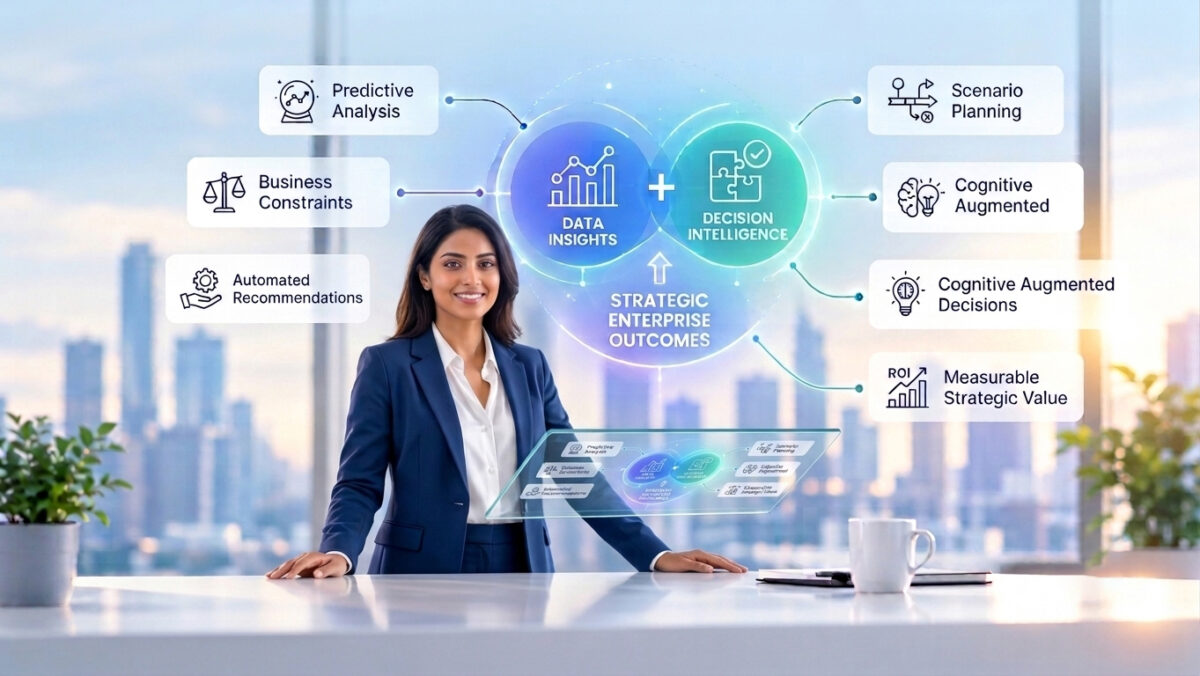
Decision intelligence combines
data, analytics, AI, business context, and human judgment
to improve the quality and speed of business decisions.
Traditional analytics often answers:
What happened?
Advanced analytics can help answer:
Why did it happen?
Predictive analytics asks:
What is likely to happen next?
Decision intelligence takes the next step:
What should we do?
And increasingly, intelligent systems can help execute that decision.
The progression becomes:
Data → Intelligence → Prediction → Decision → Action
This is a fundamental shift in how enterprises use technology.
ArthaNext approaches this through its Intelligent Systems, where AI, decision intelligence, predictive systems, intelligent workflows, and autonomous agents come together as an intelligence layer for modern enterprises.
Why Dashboards Are No Longer Enough
Dashboards transformed business reporting.
Instead of waiting for monthly reports, leaders could see revenue, costs, sales, inventory, productivity, and other metrics almost instantly.
But dashboards still require humans to interpret them.
Imagine a sales dashboard showing:
Revenue ↓ 12%
That’s information.
The next questions are more important:
Which region caused the decline?
Which products are affected?
Which customers changed their behaviour?
Is this temporary or structural?
What will happen next month?
What should the sales team do?
A dashboard can show the number.
Decision intelligence connects the number to the decision.
The Evolution of Enterprise Intelligence
The enterprise intelligence journey can be understood in five stages.
01 — DATA
What happened?
Raw information from business systems.
↓
02 — INTELLIGENCE
Why did it happen?
Analytics and contextual understanding.
↓
03 — PREDICTION
What is likely to happen?
Forecasting and predictive models.
↓
04 — DECISION
What should we do?
AI-supported recommendations and scenario analysis.
↓
05 — ACTION
What happens next?
Workflows, automation, and AI agents execute the appropriate response.
The real opportunity is connecting all five.
From Historical Reporting to Forward-Looking Intelligence
Traditional reporting is largely retrospective.
It tells businesses what happened.
For example:
Sales were ₹10 crore last quarter.
Predictive intelligence changes the question:
Sales could reach ₹11.5 crore next quarter based on current trends.
Decision intelligence goes further:
If we increase distribution in Region A and adjust pricing for Product B, the projected outcome improves.
Now the system isn’t simply describing the business.
It is helping the business decide what to do.
This is already reflected in ArthaNext’s Decision Intelligence Systems, which include decision-support systems, recommendation engines, optimization models, scenario modelling, forecasting engines, and risk intelligence systems.
The Role of AI in Decision Intelligence
AI dramatically expands what decision systems can do.
Modern AI can process large volumes of structured and unstructured information, identify patterns, summarize complex situations, generate scenarios, and support decision-making.
For enterprises, this means decision intelligence can combine information from:
ERP · CRM · Finance · HRMS · Supply Chain · Customer Data · Market Data · Documents · Operational Systems
Instead of examining each source separately, an intelligent system can bring relevant context together.
This matters because critical business decisions rarely depend on a single data point.
The best decision often sits at the intersection of multiple sources of information.
But connecting these sources is an architectural challenge as much as an AI challenge.
ArthaNext’s Enterprise Architecture & Business Platforms focuses on connecting people, processes, systems, and data into integrated digital ecosystems.
From Insights to Recommendations
Consider inventory management.
A traditional system might tell you:
Inventory for Product X is 23% above target.
An intelligent decision system can go further.
It can consider:
Current inventory
- Historical sales
- Seasonality
- Open orders
- Supplier lead times
- Regional demand
- Pricing
- Promotions
And generate:
Reduce the next purchase order by 15% and redirect existing inventory toward Region B.
Now data has become an actionable recommendation.
That’s the difference between an insight and a decision.
Decision Intelligence Across the Enterprise
Decision intelligence isn’t limited to leadership dashboards.
It can become part of everyday operations.
Finance
Detect → Analyze → Forecast → Recommend
Identify anomalies, forecast cash flows, evaluate financial risks, and support better capital allocation.
Sales
Analyze → Predict → Prioritize → Act
Identify high-value opportunities, forecast sales, understand customer behaviour, and prioritize sales actions.
Marketing
Measure → Understand → Predict → Optimize
Understand campaign performance, identify high-value audiences, and optimize budgets based on expected outcomes.
Human Resources
Understand → Predict → Intervene
Identify workforce trends, forecast hiring requirements, and support workforce planning.
Procurement
Analyze → Compare → Predict → Recommend
Evaluate suppliers, analyze pricing, forecast requirements, and recommend purchasing decisions.
Manufacturing
Monitor → Detect → Predict → Optimize
Identify production anomalies, predict maintenance requirements, optimize resources, and improve operational efficiency.
ArthaNext’s enterprise architecture capabilities cover systems such as ERP, CRM, HRMS, workflow platforms, credit systems, insurance platforms, and operational control platforms, providing the systems layer on which this intelligence can operate.
The Rise of Decision Copilots
One of the most practical applications of AI in decision intelligence is the decision copilot .
Instead of opening multiple dashboards and manually analysing information, a business leader can ask:
Why did our margins fall this quarter?
The system can analyse relevant financial, operational, and sales data and explain the major contributing factors.
Then:
What happens if we increase prices by 5%?
The system can model scenarios.
Then:
Which customers are most likely to react negatively?
The system can identify potential risks.
And eventually:
Prepare the pricing recommendations for approval.
The interaction moves from:
Dashboard → Analysis → Decision
to:
Question → Intelligence → Recommendation → Action
ArthaNext’s Intelligent Systems practice includes enterprise AI copilots, workflow copilots, finance assistants, operations copilots, enterprise search assistants, and AI-powered decision systems .
Decision Intelligence and Agentic AI
This is where Agentic AI becomes important.
Decision intelligence helps answer:
What should happen?
Agentic AI can increasingly help answer:
What needs to happen to make it happen?
For example:
An intelligent finance system identifies unusual receivables.
↓
It analyses customer history.
↓
It predicts increased payment risk.
↓
It recommends intervention.
↓
An AI agent prepares the appropriate communication.
↓
The responsible person approves it.
↓
The system updates the workflow.
The two technologies complement each other.
Decision Intelligence decides.
Agentic AI executes.
ArthaNext’s Intelligent Systems capability specifically includes goal-driven agents, autonomous workflow agents, finance agents, operations agents, research agents, and multi-agent orchestration.
Together, these technologies can create a much more intelligent operating model.
Humans Still Matter
Decision intelligence does not mean removing humans from decision-making.
Some decisions are routine and highly predictable.
Others involve:
Strategy · Relationships · Risk · Ethics · Experience · Uncertainty
Those decisions require human judgment.
The objective isn’t:
AI makes every decision.
It is:
AI gives humans better context, better options, and better timing.
A strong decision-intelligence system should make the human decision-maker more informed, not less important.
This is also why governance, security, and control need to exist alongside enterprise AI.
ArthaNext’s Infrastructure & Securitycapabilities include identity and access management, cybersecurity, data infrastructure, governance, monitoring, and secure enterprise environments.
The Importance of Context
A major weakness of traditional analytics is that data can exist without context.
A number by itself means very little.
Revenue declined 8%.
Why?
Was there a supply shortage?
Did a major customer leave?
Did pricing change?
Did a competitor enter the market?
Was demand seasonal?
Did inventory run out?
Context turns information into understanding.
AI makes it increasingly possible to combine data from multiple systems and understand these relationships.
Data tells you what changed. Context tells you why.
Building a Decision-Intelligent Enterprise
Decision intelligence shouldn’t be treated as another software product added to the technology stack.
It needs to be connected to the enterprise.
A simplified architecture looks like:
Enterprise Data
↓
Data & Integration Layer
↓
Analytics & AI
↓
Decision Intelligence
↓
Human + AI Decision
↓
Workflow / Agent
↓
Business Action
↓
Feedback
The feedback loop is important.
Every action generates new information.
That information can improve future predictions, recommendations, and decisions.
The enterprise becomes a continuous learning system.
This is why enterprise architecture becomes foundational.
ArthaNext describes enterprise architecture as the foundation that connects people, processes, systems, and data into one intelligent operating model, moving businesses from fragmented tools toward integrated digital ecosystems.
The Decision Intelligence Stack
A mature decision-intelligence environment brings together:
DATA
Reliable and accessible business information.
ANALYTICS
Understanding patterns and relationships.
AI
Extracting context and generating intelligence.
PREDICTION
Forecasting possible outcomes.
DECISION MODELS
Evaluating options and scenarios.
AGENTS & AUTOMATION
Turning decisions into actions.
GOVERNANCE
Ensuring decisions remain secure, explainable, and controlled.
ArthaNext’s Intelligent Systems architecture reflects this same layered approach, spanning the Data Layer, Intelligence Layer, Agent Layer, Workflow Layer, and Decision Layer.
Measuring the Value of Better Decisions
The value of decision intelligence isn’t measured by how sophisticated a dashboard looks.
It is measured by business outcomes.
Faster Decisions
Reduce the time between information and action.
Better Decisions
Bring more context into critical choices.
Lower Risk
Identify problems earlier.
Higher Productivity
Reduce manual analysis.
Better Forecasting
Move from hindsight to foresight.
Improved Outcomes
Turn intelligence into measurable business impact.
Ultimately, the question is simple:
Did the decision improve the business?
From Data-Driven to Decision-Driven
For years, businesses aspired to become:
Data-driven.
Then:
Analytics-driven.
The next evolution is:
Decision-driven.
A decision-driven enterprise doesn’t simply collect more information.
It builds systems that continuously connect:
Data
→ Context
→ Intelligence
→ Prediction
→ Decision
→ Action
→ Feedback
This is where AI becomes much more than a productivity tool.
It becomes part of how the business thinks.
The Future of Enterprise Decision-Making
The competitive advantage of the future won’t necessarily belong to the company with the most data.
Everyone is generating enormous amounts of data.
It will belong to organizations that can turn that data into better decisions, faster .
The journey is already moving from:
Reports → Dashboards
Dashboards → Analytics
Analytics → Intelligence
Intelligence → Decisions
Decisions → Actions
And ultimately:
Businesses that can continuously sense, understand, decide, and act will have a fundamentally different operating advantage.
The ArthaNext Perspective
At ArthaNext, we believe technology should not simply give businesses more information .
It should help them understand what matters, decide what to do, and act on it.
We combine:
Data + AI + Enterprise Architecture + Decision Intelligence + Intelligent Workflows
to build systems designed around real business outcomes.
Our Intelligent Systems practice covers decision intelligence, AI copilots, agentic AI, predictive systems, intelligent workflows, and enterprise AI architecture.
Our Enterprise Architecture practice connects applications, data, processes, integrations, and platforms into scalable business ecosystems.
And our Financial & Growth Intelligence capabilities extend intelligence into areas such as financial forecasting, revenue optimization, risk, and growth systems.
Data is valuable.
Intelligence is powerful.
But better decisions create the difference.
From Data → Intelligence → Decisions → Action.
This is the next evolution of the intelligent enterprise.
Ready to Build a More Intelligent Enterprise?
The next competitive advantage may not come from having more technology.
It may come from making the technology you already have think, connect, and act better .
Talk to ArthaNext about building intelligent systems around your business.