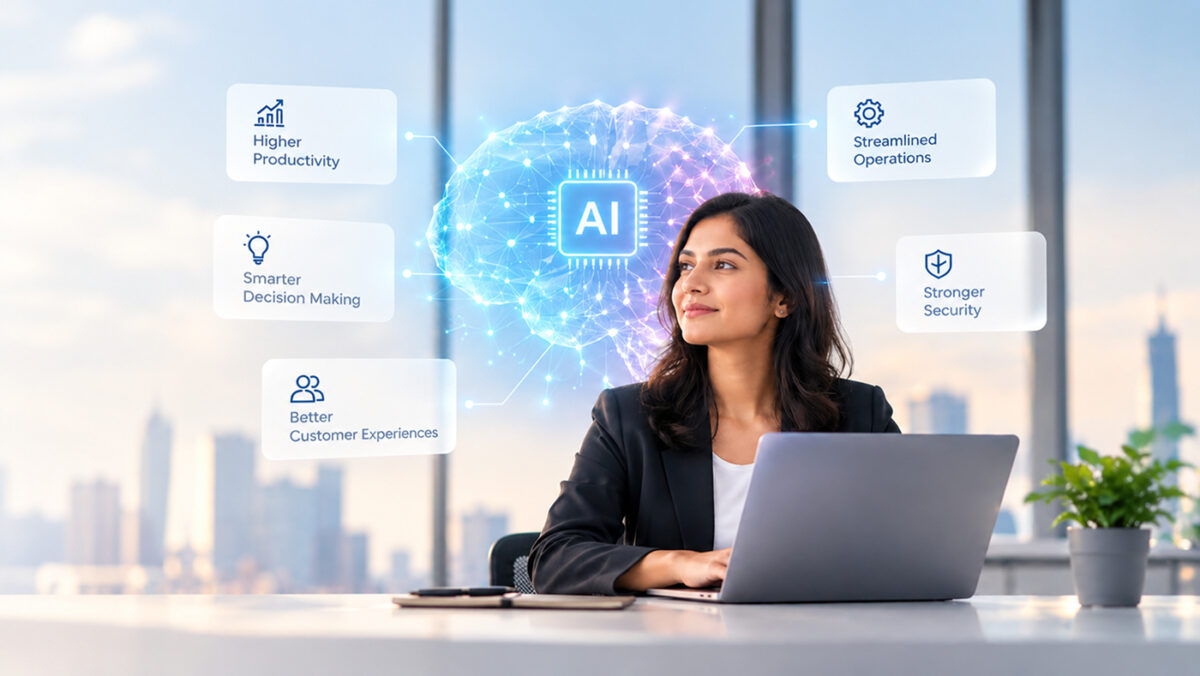
From adding AI to existing software to fundamentally changing how enterprises think, decide and operate.
Artificial intelligence has moved beyond experimentation.
Enterprises are using AI to analyze information, automate workflows, generate content, support employees and improve decision-making. Yet the bigger transformation is still ahead.
The next phase is not simply about adding AI to existing enterprise software.
It is about building enterprises where intelligence is embedded into the way work gets done.
This is the shift from AI-enabled enterprises to AI-native enterprises.
And it is likely to change not just the technology stack, but the operating model of the modern business.
What Is Native AI Transformation?
Traditional enterprise technology was built around applications.
ERP manages finance and operations.
CRM manages customers.
HRMS manages people.
Data platforms manage information.
Automation tools execute predefined workflows.
AI was initially introduced as another layer on top of these systems.
But Native AI transformation takes a different approach.
Instead of asking:
Where can we add AI?
businesses begin asking:
What would this process look like if intelligence were built into it from the beginning?
That distinction matters.
An AI-enabled procurement system might recommend a vendor.
A native AI procurement system could understand the requirement, analyze historical purchases, evaluate vendors, compare pricing, identify anomalies, recommend a decision, initiate the workflow and escalate only when human judgment is required.
The transformation is not simply better automation.
It is a different way of operating.
AI-Enabled vs AI-Native Enterprises
| AI-Enabled Enterprise | AI-Native Enterprise |
| AI added to existing applications | Intelligence embedded into workflows |
| Human-led processes | Human + AI collaboration |
| AI assists decisions | AI supports and executes decisions |
| Rule-based automation | Context-aware agents |
| Isolated AI use cases | Connected intelligence |
| Applications remain the centre | Business outcomes become the centre |
The distinction becomes particularly important as AI agents move from experimentation toward real enterprise use.
McKinsey’s 2025 State of AI research found that 62% of surveyed organizations were experimenting with AI agents, while only 23% reported scaling an agentic AI system somewhere within the enterprise.
The opportunity is therefore no longer simply adopting AI.
It is learning how to architect the enterprise around intelligence.
From Systems of Record to Systems of Action
For decades, enterprise software has primarily been built around recording transactions.
A sale happens → CRM records it.
An employee joins → HRMS records it.
A purchase happens → ERP records it.
A payment happens → financial systems record it.
These systems remain essential.
But AI introduces another layer:
Understanding what is happening.
And increasingly:
Deciding what should happen next.
And eventually:
Taking action.
A modern enterprise architecture can therefore evolve from:
Systems of Record → Systems of Intelligence → Systems of Action
This is where AI agents become particularly important.
Modern agent architectures combine an AI model with orchestration, tools, data sources and application interfaces so that an agent can process requests and interact with external systems rather than simply generate a response.
At ArthaNext, this thinking forms a core part of our [Intelligent Systems] architecture, spanning agentic AI, decision intelligence, enterprise copilots, machine learning, generative AI and intelligent workflows.
The Rise of Agentic AI in Enterprise
Generative AI changed how people interact with technology.
Agentic AI changes what technology can do.
A conventional chatbot might answer:
What is the status of this customer?”
An AI agent can potentially:
Find the customer → retrieve the relevant data → understand the context → determine the next action → update systems → notify the right person.
This changes the role of AI from an interface to an operational participant.
Enterprise agents can be designed for specific responsibilities:
- Sales agents
- Finance agents
- Operations agents
- Research agents
- Compliance agents
- Customer service agents
- HR agents
The goal isn’t to create one giant AI that runs the entire company.
It is to create specialized intelligence that understands specific business contexts and can execute specific responsibilities.
The Enterprise Becomes an Intelligent System
A modern enterprise has enormous amounts of information distributed across systems:
ERP · CRM · HRMS · Finance · Documents · Emails · APIs · Databases · IoT · Applications
The problem is rarely the absence of data.
The problem is fragmented context.
A sales team knows one part of the customer story.
Finance knows another.
Operations knows another.
The data exists, but the intelligence is disconnected.
This is where enterprise AI architecture becomes critical.
At ArthaNext, our approach to [Enterprise Architecture] connects people, processes, applications and data into integrated digital ecosystems rather than treating each application as an isolated system.
The objective is simple:
Connect the enterprise so intelligence can move through it.
From Data to Intelligence to Action
The evolution can be understood in four stages:
01 — Data
What happened?
02 — Intelligence
Why did it happen?
03 — Decision
What should happen next?
04 — Action
Can the system execute it?
This is where traditional dashboards begin to evolve.
A dashboard might show that production efficiency has fallen.
An analytics system might identify why.
A predictive system might forecast the impact.
A native AI system can potentially:
Detect → Diagnose → Recommend → Act → Monitor
This is the movement from business intelligence to business action.
ArthaNext’s Intelligent Systems practice specifically focuses on decision intelligence, predictive systems, operational intelligence and AI-driven workflows.
Native AI Will Transform Every Enterprise Function
Native AI will not be limited to technology teams.
It will change how functions operate.
Finance
Financial forecasting, anomaly detection, risk analysis and intelligent decision support.
Sales
Lead intelligence, sales forecasting, customer intelligence and automated workflows.
Human Resources
Employee support, workforce intelligence, recruitment assistance and HR operations.
Procurement
Vendor intelligence, price comparison, approvals and purchasing automation.
Customer Operations
Conversational AI, personalization, service automation and sentiment intelligence.
Manufacturing
Predictive maintenance, quality intelligence, computer vision and operational optimization.
Risk & Compliance
Continuous monitoring, anomaly detection, fraud intelligence and compliance workflows.
These are not isolated AI features.
They are components of an intelligent operating model.
AI Transformation Requires More Than AI
One of the biggest mistakes enterprises can make is treating AI transformation as a model-selection exercise.
A powerful AI model cannot compensate for:
- fragmented data
- poor integrations
- weak infrastructure
- insecure systems
- undocumented processes
- unclear governance
Native AI requires a technology foundation capable of supporting intelligence at scale.
That means:
Data Architecture
Application Architecture
Integration Architecture
Cloud Infrastructure
Security
AI Infrastructure
Governance
ArthaNext approaches this through connected capabilities across [Enterprise Architecture] and [Infrastructure & Security], covering cloud architecture, DevOps, cybersecurity, identity, data infrastructure, reliability and secure enterprise environments.
Security and Governance Become More Important — Not Less
As AI systems gain more autonomy, the consequences of incorrect decisions can become larger.
An AI agent that generates an incorrect answer is one problem.
An AI agent that can take action inside an enterprise system creates an entirely different risk profile.
This makes:
Identity
Access control
Auditability
Model governance
Data protection
Human oversight
critical parts of the AI architecture.
The NIST AI Risk Management Framework provides organizations with a structured approach to incorporating trustworthiness considerations into the design, development, deployment and evaluation of AI systems. Its Generative AI profile extends this guidance to risks associated with generative AI across the AI lifecycle.
Native AI therefore isn’t about maximum autonomy.
It is about appropriate autonomy with control.
The Infrastructure Behind Intelligent Enterprises
AI-native applications also change infrastructure requirements.
Enterprises need systems capable of handling:
Real-time data → AI workloads → APIs → agents → enterprise applications → continuous monitoring
This requires resilient cloud architecture, scalable data infrastructure, secure integrations and observability.
ArthaNext’s [Infrastructure & Security] capabilities cover cloud and DevOps, cybersecurity, identity, platform infrastructure, business continuity, data infrastructure and industrial technology systems.
The infrastructure should disappear into the background.
The intelligence should remain visible in the business outcome.
The New Role of Financial Intelligence
AI transformation also changes how businesses understand financial performance.
Traditional financial systems primarily report what happened.
Native AI can help businesses understand:
Why revenue changed.
Where risk is increasing.
Which customers are valuable.
Where margins are declining.
What demand may look like next.
Which decisions can improve growth.
This is the movement from financial reporting toward financial and growth intelligence.
ArthaNext’s [Financial & Growth Intelligence] capabilities focus on revenue, risk, financial forecasting, pricing and AI-driven growth systems.
The Human Role Is Changing
Native AI does not mean removing humans from the enterprise.
It means removing humans from unnecessary work.
Instead of spending time on:
Searching → Checking → Copying → Updating → Reporting
people can focus more on:
Judgment → Strategy → Relationships → Creativity → Exceptions
The best AI-native organizations will therefore not be completely automated.
They will be better coordinated between humans and intelligent systems.
The objective isn’t:
Human vs AI
It is:
Human + AI vs complexity.
Measuring the Value of Native AI
AI transformation should not be measured by the number of models deployed or agents created.
It should be measured through business outcomes.
Faster decisions
Reduce the distance between information and action.
Lower operational cost
Reduce repetitive manual work.
Better decisions
Bring more context into critical decisions.
Higher productivity
Give employees intelligent systems that work alongside them.
Better customer experiences
Respond faster and personalize interactions.
Scalable operations
Grow without increasing operational complexity at the same rate.
McKinsey’s latest research shows a similar gap between experimentation and enterprise value: while AI adoption is widespread, most organizations are still early in scaling it, and only 39% of respondents reported enterprise-level EBIT impact from AI.
That gap is exactly where serious transformation work begins.
How Enterprises Can Begin the Native AI Journey
Native AI transformation does not need to start with rebuilding the entire enterprise.
It can start with the right problem.
01 — Diagnose
Understand the business, workflows, data and technology landscape.
02 — Identify
Find high-value opportunities where intelligence can create measurable impact.
03 — Architect
Design the data, application, integration, AI and security foundation.
04 — Build
Develop the AI system, agent, application or intelligent workflow.
05 — Deploy
Move from prototype to production with governance and human oversight.
06 — Scale
Expand successful intelligence across functions and operations.
This mirrors ArthaNext’s broader Diagnose → Rethink → Architect → Build → Scale approach to business transformation.
The Enterprise of Tomorrow Will Be Intelligent by Design
The first generation of enterprise technology digitized processes.
The second generation connected systems.
The next generation will make those systems intelligent, contextual and increasingly autonomous.
The future isn’t another chatbot.
It isn’t another dashboard.
It isn’t simply another layer of software.
It is an enterprise where:
Data informs intelligence.
Intelligence informs decisions.
Decisions trigger action.
Actions create feedback.
And the system continuously improves.
The question is no longer whether your enterprise will use AI.
The question is how deeply AI will become part of how your enterprise works.
The future is not AI-enabled.
The future is AI-native.
ArthaNext
Technology with Purpose.
Explore ArthaNext Intelligent Systems
Explore Enterprise Architecture
Explore Infrastructure & Security
Explore Financial & Growth Intelligence