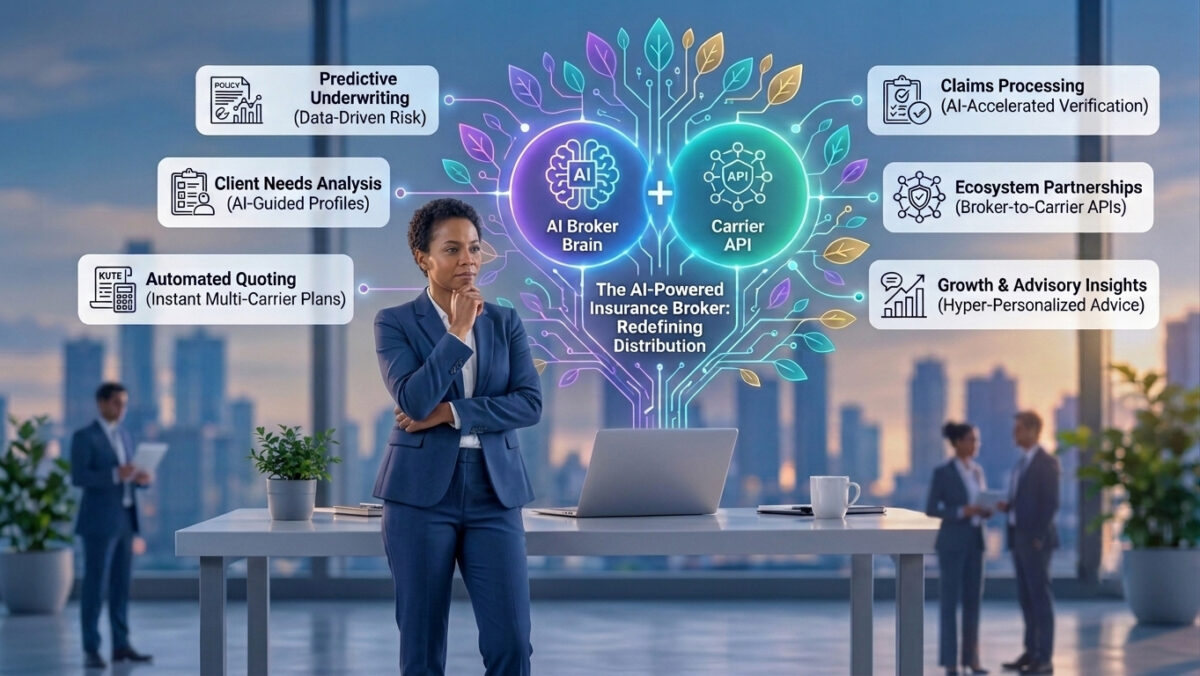
Insurance broking has always been about relationships. The next competitive advantage will be intelligence.
Insurance distribution is changing.
Customers expect faster responses, simpler processes and more transparency. Insurers are becoming increasingly digital. Product portfolios are expanding. Regulatory and documentation requirements continue to create operational complexity. And brokers are expected to manage more customers, policies and transactions without allowing service quality to decline.
For decades, the core strength of an insurance broker has been its people.
The broker understands the customer’s requirements, recommends suitable products, negotiates with insurers and helps the customer navigate the insurance lifecycle.
That relationship remains incredibly valuable.
But the operational machinery supporting that relationship is often fragmented.
Customer information may sit in a CRM. Policy details may exist in another system. Quotes may arrive through insurer portals and emails. Documents are stored separately. Renewals are tracked through spreadsheets. Claims require coordination across multiple stakeholders. Customer communication happens across email, phone and messaging platforms.
As a result, brokers can spend a significant amount of time managing information instead of managing relationships .
Artificial intelligence creates an opportunity to change that.
The future of insurance broking is not about replacing the broker. It is about giving the broker an intelligent operating layer.
The Traditional Broker’s Technology Problem
A broker’s work looks simple from the customer’s perspective.
A customer shares a requirement.
The broker understands it.
Suitable insurance products are identified.
Quotes are obtained.
The customer selects a policy.
Documentation is completed.
The policy is serviced.
Renewals are followed up.
Claims are supported when required.
But behind every one of these steps is a considerable amount of operational work.
Information has to be collected.
Documents have to be reviewed.
Data has to be entered.
Insurer portals have to be accessed.
Quotes have to be compared.
Customers have to be followed up with.
Renewal dates have to be tracked.
Claims have to be coordinated.
The larger the brokerage becomes, the more difficult this operational complexity becomes to manage.
Technology has helped automate parts of this journey, but many brokers still operate through a combination of multiple applications, spreadsheets, email, messaging platforms and insurer systems.
The broker becomes the layer connecting everything together.
And when people become the integration layer, scale becomes difficult.
From Digital Broker to AI-Powered Broker
The first wave of technology transformation made insurance broking digital.
Paper applications became digital forms.
Customer information moved into CRMs.
Policy information moved into software.
Communication became digital.
Reports became dashboards.
The next wave is different.
AI can make these digital systems intelligent .
Instead of simply storing customer information, a system can help understand it.
Instead of simply displaying policies, it can help identify relevant options.
Instead of simply showing renewal dates, it can prioritize which customers require attention.
Instead of simply storing documents, it can extract and interpret information from them.
Instead of simply recording conversations, AI can summarize them and identify next actions.
This changes the role of technology within the brokerage.
Software becomes less about recording work and more about helping perform it.
The Insurance Distribution Intelligence Layer
Imagine a broker receives a new customer requirement.
The customer may provide information through a call, email, WhatsApp message or online form.
Instead of an employee manually translating that information into multiple systems, an AI-powered platform can begin building a structured understanding of the requirement.
It can identify:
Customer profile
Insurance requirement
Relevant product category
Required information
Missing documents
Potential insurer options
Next steps
The broker still provides the expertise and recommendation.
But the technology does much of the information processing around that interaction.
This is the beginning of an insurance distribution intelligence layer .
AI Across the Insurance Lifecycle
The real opportunity becomes visible when AI isn’t restricted to one part of the business.
It can support the complete insurance journey.
Lead
AI can capture and classify incoming enquiries, understand customer requirements and prioritize opportunities.
Quote
AI can organize customer information, prepare quote requirements and help compare available options.
Policy
AI can assist with documentation, data extraction, validation and policy servicing.
Customer Service
AI can answer routine questions, retrieve policy information and route complex issues to the right person.
Claims
AI can organize claim information, extract documents, identify missing information and assist teams with claim processing.
Renewal
AI can identify upcoming renewals, prioritize customers, analyse policy history and initiate follow-up workflows.
The result is a continuous cycle:
Acquire → Advise → Quote → Issue → Service → Claim → Renew
with intelligence embedded across every stage.
The AI-Powered Broker Doesn’t Just Respond. It Anticipates.
Traditional brokerage is often reactive.
A customer asks a question.
The broker responds.
A policy approaches renewal.
The team follows up.
A document is missing.
Someone requests it.
A claim is filed.
The team begins processing it.
AI creates the possibility of becoming more proactive.
Imagine a system identifying customers whose policies are approaching renewal and automatically prioritizing them based on value, policy type, past engagement and other relevant signals.
Or identifying customers who may need additional coverage based on changes in their profile.
Or highlighting policies where documentation is incomplete before the renewal process begins.
Or alerting a broker that a customer has multiple policies across different products and may benefit from a broader review.
The system is no longer waiting for an employee to discover the opportunity.
It is continuously looking for what needs attention.
From CRM to Customer Intelligence
CRM systems have become essential to insurance distribution.
But a CRM fundamentally records interactions.
The next generation of insurance technology can go further.
An AI-powered customer intelligence layer can help answer:
Who is this customer?
What policies do they have?
What have they purchased previously?
What conversations have taken place?
What services have they requested?
What is coming up next?
What might they need?
This creates a more complete customer view.
Instead of an employee searching through multiple records before speaking to a customer, the system can provide relevant context upfront.
The result is not just better information.
It is a better customer conversation.
The best technology should make the broker feel more informed—not less human.
AI Agents: The Next Step in Insurance Broking
AI assistants can help employees.
AI agents can potentially perform work .
Consider a renewal process.
A traditional workflow might require an employee to:
Check upcoming renewals.
Open the customer record.
Review the existing policy.
Collect required information.
Contact the customer.
Request documents.
Coordinate with insurers.
Compare options.
Prepare communication.
Update the system.
Follow up again.
An AI agent could potentially handle many of these operational steps within defined boundaries.
It could identify an upcoming renewal, gather relevant information, prepare the renewal case, generate required communications, update systems and escalate the case to the broker when human judgment is required.
The broker remains in control.
But the operational workload is reduced.
This creates a new model:
AI handles coordination.
The broker handles judgment.
The next insurance broker may have an AI workforce operating behind every human employee.
The Human Broker Becomes More Valuable
There is a reason insurance broking has remained relationship-driven despite decades of technological change.
Insurance can be complicated.
Customers don’t always know what coverage they need.
Businesses have different risk profiles.
Policies contain nuances that require interpretation.
Large or complex risks require negotiation and judgment.
When something goes wrong, customers want someone they trust.
AI cannot replace these relationships.
Instead, it can remove much of the operational work surrounding them.
A broker who previously managed 100 customers through heavily manual processes may eventually be able to manage significantly more relationships with the support of intelligent systems.
That doesn’t necessarily make the broker less important.
It increases the amount of business each broker can intelligently manage.
The New Economics of Insurance Distribution
This has an important business implication.
Traditional growth often requires adding more people as customer volume increases.
More customers mean more:
Calls
Documents
Follow-ups
Policy updates
Renewals
Service requests
Claims coordination
Technology can change this relationship.
If AI can absorb some of the information processing, administrative work and repetitive coordination, brokerages can potentially grow without increasing operational workload at the same rate.
This can create operating leverage.
The goal isn’t simply to reduce costs.
It is to allow the organization to use its people where they create the most value.
AI can turn operational capacity into a growth advantage.
Why an AI Chatbot Isn’t Enough
It is tempting to define an AI-powered broker as a chatbot on a website.
But that is only one small part of the opportunity.
A chatbot can answer questions.
An intelligent insurance platform should be able to understand the business behind the question.
It should potentially connect with:
Customer data
Policy systems
Insurer information
Documents
Payments
Claims
Renewals
Communication channels
Analytics
Enterprise applications
The intelligence becomes valuable when it can operate across the complete business environment.
The future of insurance AI isn’t just conversational. It’s operational.
The Importance of a Connected Insurance Platform
For AI to work effectively, the underlying systems need to work together.
A broker may have one system for customers, another for policies, separate insurer portals, accounting software, communication tools and document repositories.
If these systems remain disconnected, AI has limited visibility.
This is why the future of insurance technology requires more than AI models.
It requires a connected technology foundation.
Data + Applications + Integrations + AI + Workflows
Together, they create the infrastructure for intelligent insurance distribution.
This is also where ArthaNext’s broader approach to enterprise platforms and architecture becomes relevant—connecting applications, data, processes and integrations rather than treating each technology initiative as an isolated system.
AI Can Help Brokers Move From Selling to Understanding
Insurance distribution has traditionally been product-oriented.
A customer needs insurance.
The broker finds an appropriate policy.
The transaction is completed.
AI creates the possibility of a more customer-centric model.
The system can build a broader understanding of the customer and their evolving needs.
This means the broker can potentially move from:
“Which policy can I sell?”
toward:
“What risks does this customer have, and how can I help address them?”
That is a more powerful relationship.
It shifts the broker’s role from being primarily a distributor of insurance products toward becoming a risk and protection advisor.
The Data Advantage
AI also creates a significant opportunity for brokerages to make better use of the data they already possess.
A mature brokerage may have years of information across customers, policies, claims, renewals, insurer relationships and transactions.
Historically, much of this data has been used for reporting.
AI can potentially turn it into intelligence.
Organizations can begin asking:
Which customers are most likely to renew?
Which policies are approaching renewal risk?
Which products are performing best?
Which customers have cross-sell opportunities?
Where are service bottlenecks occurring?
Which processes consume the most employee time?
Which insurer relationships perform best for specific categories of business?
The value of the data increases when it can influence decisions and actions.
Data becomes more valuable when it moves from reports to decisions.
Trust and Responsible AI
Insurance is a high-trust business.
Customer information can be sensitive. Policy decisions can have financial consequences. AI recommendations need to be understandable and appropriately governed.
An AI-powered insurance platform therefore needs more than intelligence.
It needs:
Security
Access controls
Data governance
Auditability
Human oversight
Clear decision boundaries
AI should support professional judgment rather than create uncontrolled automated decision-making.
For brokers, this is especially important because trust is part of the product they deliver.
The technology behind the relationship must therefore be as reliable as the relationship itself.
What Should Insurance Brokers Do Now?
Becoming an AI-powered broker doesn’t require rebuilding the entire business overnight.
The transformation can begin with specific, high-friction processes.
Start by identifying where teams spend the most time.
Perhaps it is:
Lead processing
Quote preparation
Document handling
Customer servicing
Renewals
Claims coordination
Then introduce intelligence where it can create measurable value.
Start with AI-assisted workflows.
Connect the underlying systems.
Measure the results.
Then progressively introduce AI agents into workflows where the process is well-defined and appropriate levels of human oversight can be maintained.
The goal should always be business outcomes.
Faster response.
Higher productivity.
Better customer experience.
Greater retention.
More scalable operations.
Higher revenue per employee.
From Broker to Intelligent Insurance Platform
The long-term opportunity is bigger than simply making existing brokerage processes faster.
It is about changing the operating model of the brokerage.
The traditional model is:
People → Processes → Applications
The emerging model is:
People + AI → Intelligent Workflows → Connected Systems → Action
The broker remains at the centre of the customer relationship.
But around the broker is an intelligent technology layer that continuously processes information, identifies opportunities, automates routine work and brings important decisions to the right person.
This creates what could become the intelligent insurance platform.
The ArthaNext Perspective
At ArthaNext, we see insurance technology moving from disconnected digital tools toward integrated and intelligent insurance ecosystems.
Our approach is to bring together business platforms, insurance workflows, AI, data, integrations and enterprise technology to support the complete insurance lifecycle.
From customer onboarding and policy management to payments, servicing, renewals and claims, the objective is to create technology that works around the way insurance businesses actually operate.
The next generation of insurance platforms will not simply store policy information.
They will help brokers:
Understand customers.
Identify opportunities.
Process information.
Make better decisions.
Automate workflows.
Act faster.
And ultimately, serve more customers without losing the human relationship that makes insurance broking valuable.
The Future of Insurance Distribution
Insurance distribution has always been built on trust.
Technology isn’t going to change that.
What technology can change is everything that happens around that relationship.
Less manual data entry.
Less searching.
Less repetitive follow-up.
Less fragmented information.
Less time spent moving data between systems.
More customer conversations.
More intelligent recommendations.
More proactive service.
More capacity.
More time for the broker to do what the broker does best.
The future of insurance broking isn’t humans versus AI.
It’s brokers with intelligence.
And the organizations that embrace this shift will not simply operate faster.
They will be able to understand customers better, respond faster, scale more efficiently and build stronger relationships.
That is what makes AI in insurance distribution more than an automation story.
It is an opportunity to redesign the insurance broker itself.
About ArthaNext
ArthaNext builds intelligent systems, enterprise platforms, digital infrastructure and technology solutions designed around complex business challenges.
We help organizations move from fragmented technology and manual processes toward connected, intelligent and outcome-driven enterprises .