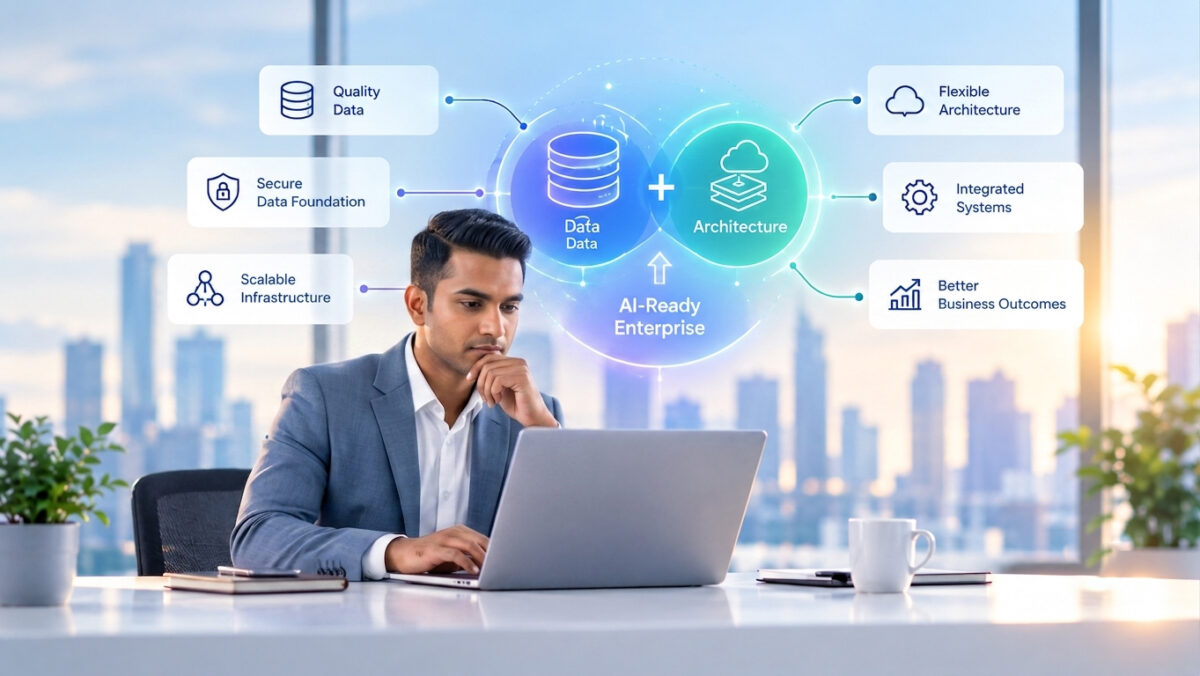
Everyone wants AI. But AI is only as powerful as the enterprise foundation it can access.
The conversation around enterprise AI has changed rapidly.
Businesses are experimenting with copilots, generative AI, predictive analytics and AI agents. The technology is becoming increasingly accessible.
But there is a less exciting—and far more important—question:
Is your enterprise actually ready for AI?
Because deploying an AI model is relatively easy.
Making AI work reliably across a complex enterprise is much harder.
The difference often comes down to two things:
Data and architecture.
AI Doesn’t Fix a Broken Enterprise
Imagine giving an AI agent access to a business where:
- Customer data sits in multiple systems.
- Finance operates on another platform.
- Documents are scattered across drives and emails.
- Legacy applications don’t communicate with each other.
- Data has inconsistent formats.
- APIs are limited or unreliable.
- Permissions are unclear.
The AI model may be excellent.
But it doesn’t have the context, connectivity or authority required to do meaningful work.
This creates an important principle:
AI cannot compensate for a fragmented enterprise.
It can expose the fragmentation.
It can sometimes work around it.
But at scale, the foundation has to change.
The AI Model Is Only One Layer
When companies think about AI, the model often gets most of the attention.
Which model should we use?
Which LLM is better?
Should we use a proprietary model or an open-source model?
These questions matter.
But they are only one part of the architecture.
A production-grade enterprise AI system typically needs:
Data → Models → Context → Tools → APIs → Security → Governance → Applications → Workflows
The model sits somewhere in the middle.
The model is the brain. The enterprise architecture is the body.
A powerful brain cannot accomplish much without the ability to see, communicate and act.
Data Is the Real AI Infrastructure
Every intelligent system depends on information.
But enterprise data rarely exists in one clean, unified place.
It lives across:
ERP
CRM
HRMS
Finance
Documents
Emails
Databases
Cloud platforms
IoT systems
Operational applications
Customer interactions
AI needs to bring these sources together without losing context, quality, security or traceability.
McKinsey’s June 2026 research identifies data readiness as a key constraint to scaling enterprise AI, highlighting the need to connect structured and unstructured data into a governed, reusable foundation.
This means AI readiness begins long before the AI model is selected.
AI-ready data must be accessible, connected, contextual, governed and trustworthy.
From Data Silos to an Enterprise Data Layer
Traditional enterprises often look like this:
Application A → Data
Application B → Data
Application C → Data
Application D → Data
Each system knows its own version of the business.
AI needs a broader view.
The modern architecture increasingly needs a connected data layer where information can be discovered, governed and accessed across systems.
Conceptually:
Enterprise Data
↓
Context & Intelligence Layer
↓
AI Models & Agents
↓
Business Applications
↓
Actions
The objective isn’t necessarily to replace every existing system.
It is to make the systems work together.
Legacy Systems Aren’t the Enemy
One common assumption is that an enterprise needs to replace its legacy systems before adopting AI.
That isn’t always true.
Most large organizations have years of investment in ERP, CRM, HR, finance and operational systems.
The challenge is not necessarily replacing them.
It is connecting them intelligently.
APIs, integration layers, event-driven architecture, data platforms and intelligent orchestration can allow new AI capabilities to work with existing technology.
This creates a more practical approach:
Keep what works.
Connect what is disconnected.
Intelligentize what creates value.
Replace what genuinely limits the business.
That is the difference between an AI project and an enterprise transformation strategy.
APIs Become the Bridge Between AI and the Enterprise
An AI model can understand a request.
But understanding is not execution.
If an AI agent needs to:
- Create a purchase order
- Update a CRM record
- Check inventory
- Process an invoice
- Retrieve an employee record
- Initiate a workflow
it needs a secure way to interact with enterprise systems.
This is where APIs and enterprise integrations become critical.
The architecture starts looking like:
User Intent
↓
AI Agent
↓
Reasoning
↓
Tools / APIs
↓
Enterprise Systems
↓
Action
The agent becomes an intelligent interface between people and enterprise systems.
APIs give AI hands.
The Rise of the Intelligence Layer
Traditional enterprise software primarily answers:
What happened?
Dashboards and reporting systems made information visible.
The next generation asks:
Why did it happen?
Predictive analytics and decision intelligence bring context.
And increasingly:
What should happen next?
Agentic systems can potentially take the next step.
This creates a new enterprise layer:
The Intelligence Layer
It sits across data, applications and workflows to help transform:
Data → Understanding → Decision → Action
This is central to the idea of the intelligent enterprise.
At ArthaNext, our [Intelligent Systems] approach combines AI, decision intelligence, predictive systems, agentic workflows and enterprise data to move organizations from information toward action. ArthaNext Intelligent Systems
Architecture Determines What AI Can Actually Do
Consider two enterprises.
Enterprise A
Has an AI chatbot.
It can answer questions based on a limited knowledge base.
Enterprise B
Has connected enterprise data, APIs, workflows, identity, security and AI agents.
Its AI can:
Understand a request
→ Find relevant information
→ Check business context
→ Interact with systems
→ Execute a workflow
→ Record the action
→ Escalate when necessary
Both enterprises have AI.
But they have completely different levels of AI capability.
The difference isn’t the model.
The difference is the architecture around the model.
Security Has to Be Built Into the Architecture
As AI moves from answering questions to taking actions, security becomes even more important.
An enterprise AI system needs to answer:
Who can access this data?
Which agent can access it?
What can this agent do?
What requires human approval?
What actions are being recorded?
How can decisions be audited?
What happens when something goes wrong?
NIST’s AI Risk Management Framework recommends organizations incorporate trustworthiness and risk management throughout the AI lifecycle, with governance, mapping, measurement and management as core functions.
Its Generative AI Profile extends that thinking to risks that are specific to or amplified by generative AI.
The implication for enterprises is straightforward:
AI security cannot be bolted on after deployment.
It needs to be part of the architecture from day one.
The AI-Ready Enterprise Architecture
A modern AI-ready enterprise can be thought of as seven connected layers:
01 — Data
Structured and unstructured enterprise information.
02 — Integration
APIs, connectors and event-driven communication.
03 — Applications
ERP, CRM, HRMS, finance and operational systems.
04 — Intelligence
AI models, analytics, decision intelligence and knowledge systems.
05 — Agents
Systems capable of reasoning, coordinating and executing defined tasks.
06 — Security
Identity, access, governance, monitoring and controls.
07 — Experience
The interfaces through which employees, customers and leadership interact with intelligence.
Together, these create something far more valuable than an AI model.
An enterprise intelligence architecture.
What Does an AI-Ready Enterprise Look Like?
It doesn’t necessarily mean every process is autonomous.
It means the enterprise has the foundations required to introduce intelligence where it creates value.
A customer-service system can understand customer history.
A finance system can detect unusual activity.
A factory can identify operational anomalies.
An HR platform can understand employee context.
A sales system can prioritize opportunities.
A leadership platform can bring together information from across the organization.
The common thread is:
Connected data + intelligent systems + actionable workflows.
The Journey to Becoming AI-Ready
Enterprise AI transformation doesn’t have to begin with rebuilding everything.
It should begin with understanding what already exists.
01 — Assess
Map applications, data, processes, infrastructure and integrations.
02 — Identify
Find the business processes where AI can create measurable value.
03 — Connect
Build the data and integration foundation required to access context.
04 — Architect
Design the AI, application, security and infrastructure layers.
05 — Pilot
Start with focused, high-value use cases.
06 — Scale
Expand successful intelligence across the organization.
The goal isn’t to become “AI-first” overnight.
The goal is to become AI-ready by design.
Build Around Business Outcomes, Not Technology
One of the biggest mistakes enterprises can make is starting with:
“Which AI technology should we deploy?”
The better starting point is:
“Which business problem should become dramatically better?”
Maybe it is reducing customer response time.
Maybe it is improving financial visibility.
Maybe it is reducing manual operations.
Maybe it is increasing sales productivity.
Maybe it is improving manufacturing quality.
Maybe it is accelerating decision-making.
Once the outcome is clear, the technology architecture becomes much easier to define.
Business outcome first. Technology second.
The Competitive Advantage Won’t Be the Model
AI models will continue to evolve.
Today’s best model may not be tomorrow’s.
Model capabilities will become increasingly accessible.
That means the long-term competitive advantage will not simply come from having access to a particular AI model.
It will come from what an enterprise has built around AI:
Proprietary data
Deep business context
Connected systems
Intelligent workflows
Enterprise integrations
Operational knowledge
Security
Governance
Human + AI collaboration
The model can be replaced.
The intelligent enterprise you build around it becomes the advantage.
The AI-Ready Enterprise Is Already Being Built
The transition is already underway.
Enterprises are moving from:
Applications → Platforms
Data → Intelligence
Automation → Agents
Dashboards → Decision Systems
Workflows → Intelligent Workflows
Software → Digital Employees
But none of this happens by simply purchasing an AI tool.
It requires an architecture capable of supporting the transformation.
At ArthaNext, our [Enterprise Architecture] practice focuses on connecting applications, data, integrations, cloud infrastructure and digital platforms into scalable enterprise ecosystems. ArthaNext Enterprise Architecture
Our [Infrastructure & Security] capabilities provide the cloud, DevOps, cybersecurity, identity and infrastructure foundation required to run these systems securely at scale. ArthaNext Infrastructure & Security
The Future Belongs to Intelligent Enterprises
The first generation of enterprise technology digitized work.
The second generation connected work.
The next generation will intelligentize work.
And that transformation won’t be defined by the AI model alone.
It will be defined by how well the enterprise can connect:
Data
↓
Systems
↓
Intelligence
↓
Decisions
↓
Actions
AI is not the architecture.
AI is what the architecture enables.
The enterprises that understand this will be better positioned to move beyond AI experimentation and build intelligence into the way their organizations actually operate.
ArthaNext
At ArthaNext, we build intelligent systems and enterprise technology designed around business outcomes.
We bring together:
AI + Data + Enterprise Architecture + Infrastructure + Applications + Security
to help organizations move from fragmented technology to connected, intelligent systems.
Don’t just add AI to your enterprise.