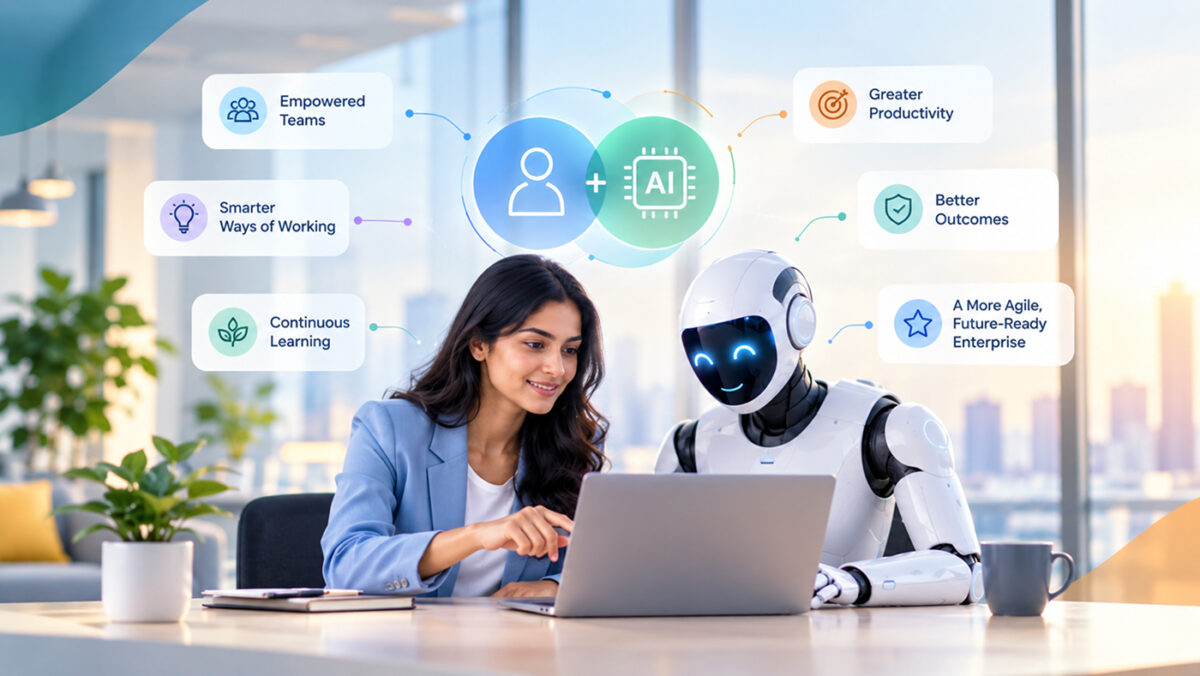
The future of work isn’t Human vs. AI. It’s Human + AI.
For decades, technology has changed the way businesses work. Computers replaced paper-based processes. Enterprise software replaced spreadsheets and manual record-keeping. Cloud platforms made information accessible from almost anywhere, while automation reduced the amount of repetitive work employees had to perform.
Artificial intelligence is taking this evolution one step further.
AI is no longer limited to generating content or answering questions. It can analyse large volumes of information, understand context, identify patterns, make recommendations, interact with enterprise systems and, increasingly, execute multi-step workflows.
That changes the question enterprises need to ask.
It is no longer simply “Where can we use AI?”
The more important question is:
“If AI can participate in the work, how should we redesign the work itself?”
This is the beginning of the Human + AI enterprise.
AI Is Changing Work, Not Just Automating Tasks
Much of the early conversation around enterprise AI focused on automation.
Businesses looked for repetitive tasks that could be automated: generating reports, responding to routine queries, extracting information from documents, processing transactions or moving data between systems.
Automation remains valuable. But AI introduces a fundamentally different capability.
Traditional automation generally follows predefined rules:
If X happens → do Y.
AI can operate with greater flexibility. It can interpret information, work with unstructured data, understand natural language, identify patterns and respond to situations that were not explicitly programmed in advance.
Consider a customer service team.
Traditional automation might automatically send a response when a customer submits a particular type of request.
An AI-enabled system can understand the customer’s message, examine their history, identify the underlying issue, determine whether it is routine or sensitive, recommend a response and potentially initiate the appropriate workflow.
The technology is no longer simply automating a task.
It is participating in the process.
That distinction is fundamental to understanding where enterprise AI is heading.
From Employees Using Software to Employees Working With Intelligence
The traditional enterprise software model looks something like this:
Employee → Application → Data → Task
Employees are expected to know which application to open, where information resides, what reports to access and how to complete the workflow.
The emerging model is different:
Employee → AI → Enterprise Systems → Action
An employee can increasingly express an objective in natural language rather than navigating multiple systems manually.
A sales manager might ask:
“Which customers should my team focus on this week?”
Instead of opening the CRM, reviewing customer histories, checking order data, examining previous interactions and building a report, an intelligent system can bring those sources together and present the relevant context.
The manager still makes the decision.
But the work required to reach that decision changes dramatically.
This is the opportunity behind ArthaNext Intelligent Systems, which brings together AI copilots, decision intelligence, predictive systems, intelligent workflows and agentic AI to create intelligence layers around business functions.
The objective isn’t simply to introduce another AI interface.
It is to make the enterprise itself more intelligent.
The Rise of the AI Workforce
The idea of an “AI workforce” can sound futuristic, but many organizations are already moving toward a model where human employees work alongside multiple forms of AI.
The first layer is the AI copilot.
A copilot assists an employee with tasks such as research, analysis, writing, summarization, information retrieval and decision support. It increases the individual’s capacity without taking complete ownership of the workflow.
The next layer is the AI agent.
An agent can be given a goal and perform a series of actions to achieve it. Rather than simply answering a question, it can potentially gather information, interact with applications, make decisions within defined boundaries and complete parts of a business process.
Then there are digital workers and intelligent workflow systems that can operate continuously across specific operational functions.
This doesn’t mean companies will suddenly replace human teams with machines.
A more realistic model is a workforce where different types of intelligence are combined.
Humans provide judgment, context, relationships and accountability.
AI provides speed, scale, analysis and execution.
The competitive advantage will come from designing the interaction between the two.
Every Function Gets an Intelligence Layer
The most significant opportunity is not necessarily creating one company-wide AI assistant.
It is embedding intelligence into the functions where decisions and execution happen every day.
Sales
A sales team spends significant time researching prospects, reviewing customer history, preparing proposals, updating CRM systems and determining which opportunities deserve attention.
An AI sales layer can bring these activities together. It can identify high-value opportunities, summarize customer interactions, highlight risks and recommend the next best action.
The salesperson remains responsible for the relationship. AI reduces the information and administrative burden around it.
Finance
Finance teams work with enormous amounts of structured and unstructured information. AI can help identify anomalies, analyse financial patterns, prepare reports, forecast outcomes and surface potential risks.
Instead of discovering a problem after a reporting cycle, intelligent systems can increasingly help organizations identify issues while they are developing.
Human Resources
HR is another function where context matters. Employees need answers about policies, benefits, documents, processes and organizational information, while HR teams need to analyse workforce trends and manage large volumes of administrative work.
An HR intelligence layer can make organizational information more accessible while helping HR teams focus on people and strategic workforce decisions.
Operations
Operations may offer the greatest opportunity for AI-driven transformation because processes are often distributed across multiple systems and involve continuous decision-making.
AI can monitor information, identify exceptions, recommend actions and trigger workflows.
This is particularly powerful when combined with enterprise systems, operational data and agentic workflows.
Marketing
Marketing teams already use technology to automate campaigns and measure performance. The next step is using intelligence to understand what is happening across channels, identify opportunities, generate content, optimize campaigns and continuously learn from results.
Leadership
For business leaders, the value may be even greater.
Instead of spending hours collecting information from different departments, leaders can increasingly interact with an intelligence layer that explains what changed, why it changed, what could happen next and where attention is required.
This moves leadership from reporting and monitoring toward sensing and decision-making.
The Manager’s Role Is Changing
AI will not only change the work performed by employees. It will change management itself.
Managers have traditionally spent a significant amount of time collecting updates, following up with teams, preparing reports, tracking tasks and coordinating information across departments.
As intelligent systems become capable of handling more of this coordination, the manager’s role can shift.
The manager spends less time asking:
“What is the status?”
and more time asking:
“What needs my attention?”
That is a meaningful change.
When information becomes easier to access and routine coordination becomes increasingly automated, management can focus more on coaching people, solving complex problems, allocating resources and making strategic decisions.
AI can reduce management friction. It cannot replace leadership.
Leadership still requires judgment, accountability and the ability to make decisions when the available information is incomplete.
The Human Advantage Becomes More Valuable
The discussion around AI and employment is often framed as a competition between humans and machines.
That framing misses an important point.
AI is exceptionally good at processing information at scale. It can analyse patterns, generate possibilities, summarize large amounts of content and execute defined workflows.
Humans bring different capabilities.
We understand relationships.
We interpret ambiguity.
We build trust.
We exercise judgment.
We understand organizational culture.
We take responsibility for difficult decisions.
We create meaning from situations that cannot always be reduced to data.
As AI takes over more information-heavy work, these human capabilities can become more valuable rather than less.
The objective should therefore not be to remove humans from the process.
It should be to remove unnecessary work from humans.
That distinction matters.
The New Enterprise Skill: AI Fluency
The organizations that benefit most from AI will not necessarily be those with the largest AI budgets.
They will be organizations where people know how to work effectively with intelligent systems.
This requires a new form of organizational capability: AI fluency.
Employees need to understand how to ask better questions, validate AI outputs, provide context, identify limitations and determine when human judgment is required.
Managers need to understand how AI changes workflows and how teams should interact with AI agents.
Leaders need to understand where AI creates genuine business value and where it creates unnecessary complexity.
This means AI transformation is also a people transformation.
Technology can provide the capability.
People determine how that capability is used.
Don’t Add AI to Yesterday’s Processes
One of the biggest mistakes an enterprise can make is taking an inefficient process and simply adding AI to it.
Imagine a process involving five disconnected applications, multiple spreadsheets, manual approvals and repeated data entry.
Adding an AI assistant to one step may make that step faster.
But the overall process may still be inefficient.
True transformation requires a different question:
If we were designing this process today, knowing what AI can do, how would we design it?
That could mean removing unnecessary steps.
Connecting previously isolated systems.
Changing approval structures.
Introducing AI at the point where decisions are made.
Allowing agents to execute routine workflows.
Giving employees a single intelligence layer rather than forcing them to navigate multiple applications.
This is where enterprise architecture becomes critical.
ArthaNext’s Enterprise Architecture & Business Platforms focuses on connecting applications, data, processes and integrations into integrated digital ecosystems.
Because AI transformation without an underlying technology architecture can quickly become another collection of disconnected tools.
The goal isn’t to put AI inside old processes.
The goal is to build better processes around intelligence.
From Automation to Augmentation to Autonomy
The transition to a Human + AI enterprise will not happen in one step.
It is more useful to think about it as a progression.
Automation
Technology performs a predefined task.
Human → System → Task
Augmentation
AI helps a person perform a task better.
Human + AI → Better Task
Intelligence
AI analyses information and provides recommendations.
Human + AI → Better Decision
Autonomy
AI agents execute defined workflows toward a business objective.
Human → AI Agent → Action
Most enterprises will operate across all four levels simultaneously.
Some processes will remain fully human.
Some will be automated.
Some will be AI-assisted.
Others will become increasingly autonomous.
The important question is not:
“How autonomous can we make everything?”
It is:
“Where does autonomy create the most business value while maintaining appropriate control?”
The Importance of Trust, Security and Governance
As AI becomes more deeply embedded in enterprise workflows, the consequences of mistakes also become more significant.
An AI system that generates an imperfect marketing draft is one thing.
An AI system that makes a financial recommendation, changes a customer record or initiates an operational process requires much stronger controls.
Enterprises therefore need to think about AI alongside:
Identity
Access
Security
Data governance
Monitoring
Human oversight
Auditability
Risk management
This is why intelligent enterprise transformation cannot be separated from infrastructure and security.
ArthaNext’s Infrastructure & Security capabilities cover infrastructure, cloud, cybersecurity, identity, access and governance requirements that support secure enterprise technology environments.
The more capable AI becomes, the more important responsible deployment becomes.
Autonomy without governance is not transformation. It’s risk.
Building the Human + AI Enterprise
Organizations don’t need to transform every process simultaneously.
A practical approach begins with understanding how work happens today.
First, identify processes that consume significant amounts of employee time.
Then identify where work is highly repetitive, information-heavy, decision-intensive or dependent on multiple disconnected systems.
From there, organizations can prioritize opportunities based on potential business value.
The first step may be a simple AI copilot.
The next could be a decision-intelligence system.
A successful workflow can then evolve into an AI agent capable of executing defined actions.
Over time, these individual capabilities can become connected.
The result is not simply an organization with many AI tools.
It is an organization where AI becomes part of the operating model.
What Should Enterprises Measure?
AI adoption shouldn’t be measured by the number of models deployed, tools purchased or employees given access to an AI assistant.
The more meaningful measures are business outcomes.
Are employees spending less time on administrative work?
Are decisions happening faster?
Are errors decreasing?
Can teams handle more work without proportionally increasing headcount?
Are customers receiving faster responses?
Are managers spending more time on strategic activities?
Are risks being identified earlier?
Is the organization generating more value from the same resources?
These are the metrics that determine whether AI transformation is actually working.
AI success is ultimately a business metric, not a technology metric.
The Enterprise of the Future
The enterprise of the future will not be completely human.
Nor will it be completely autonomous.
It will be a combination of both.
Humans will continue to define objectives, build relationships, exercise judgment, lead teams and take accountability.
AI will increasingly process information, identify patterns, provide recommendations and execute defined workflows.
Enterprise systems will provide the data and infrastructure connecting everything together.
The result is a new operating model:
Human Intelligence
Artificial Intelligence
Connected Enterprise Systems
=
Intelligent Enterprise
This is a much more powerful idea than simply “using AI.”
It means designing the organization itself around the capabilities of both humans and machines.
The ArthaNext Perspective
At ArthaNext, we believe enterprise AI transformation is not about adding another tool to an already complicated technology stack.
It is about creating a more intelligent way for the business to operate.
That requires more than an AI model.
It requires the right combination of data, architecture, business applications, intelligence, workflows, infrastructure and people.
Our Intelligent Systems capabilities bring together AI copilots, decision intelligence, predictive systems, intelligent workflows and agentic AI.
Our Enterprise Architecture & Business Platforms capabilities connect applications, data, processes and integrations into scalable business ecosystems.
And our Infrastructure & Security capabilities provide the secure foundation required to operate these systems reliably.
The objective across all of them is the same:
Make technology work better for the people running the business.
The Next Generation of Work
The biggest impact of AI may not be that machines can perform more tasks.
It may be that humans can finally spend less time doing work that machines are better suited to perform.
Less time searching.
Less time copying data.
Less time preparing repetitive reports.
Less time coordinating routine workflows.
Less time navigating disconnected systems.
And more time:
Thinking.
Creating.
Deciding.
Leading.
Building.
That is the real promise of the Human + AI enterprise.
Not a workplace where humans become less important.
A workplace where technology creates more room for human intelligence to matter.
The future of work isn’t Human vs. AI.
It’s Human + AI.
About ArthaNext
ArthaNext builds intelligent systems, enterprise platforms, digital infrastructure and technology solutions designed around complex business challenges.
We help organizations move from fragmented technology and manual processes toward connected, intelligent and outcome-driven enterprises.